
羅文杏老師《Promoting Taiwan to be a Bilingual Country》
| 講者介紹 | 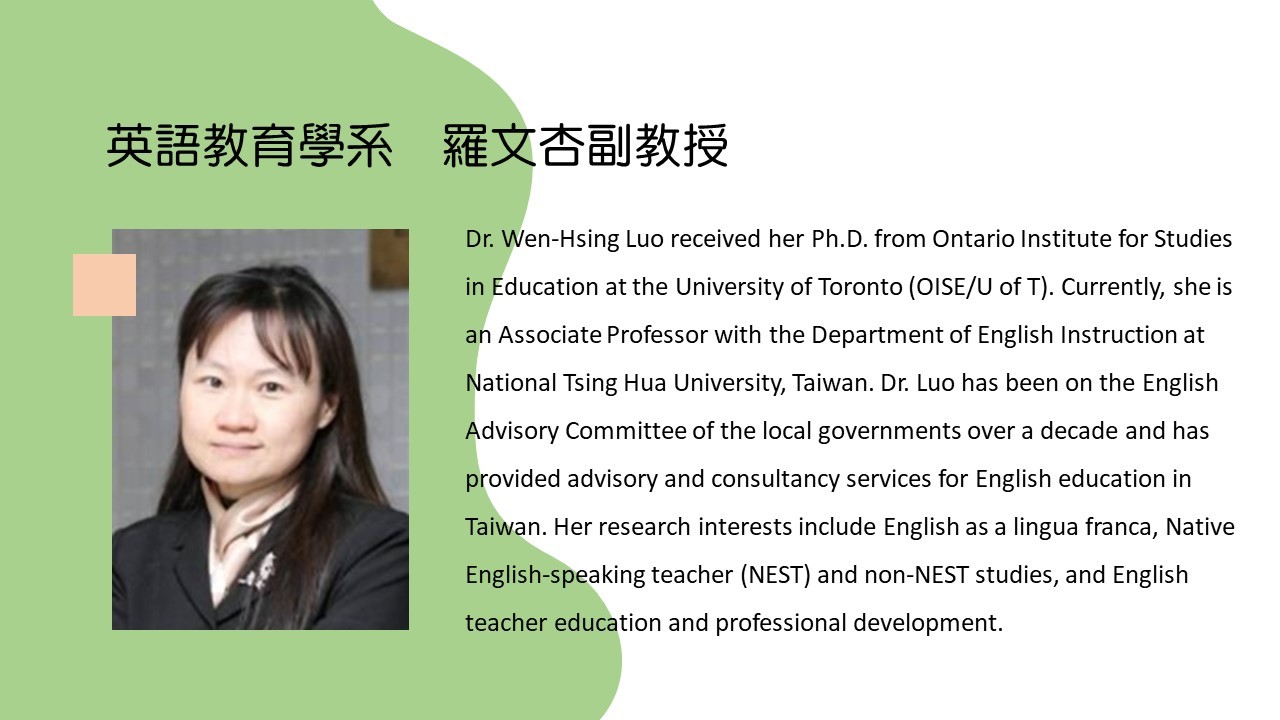 |
|---|---|
| 活動紀錄 | ||
|---|---|---|
|
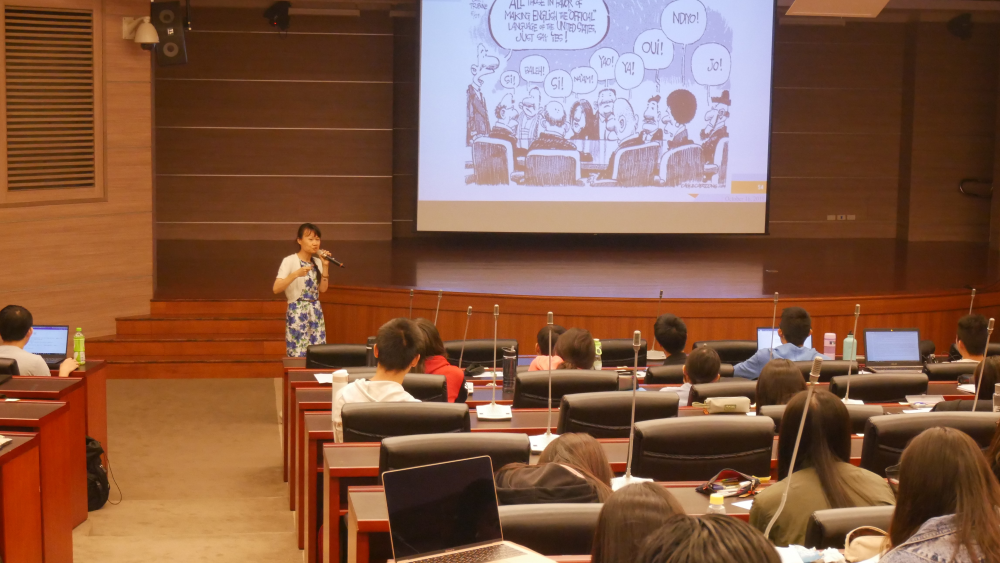
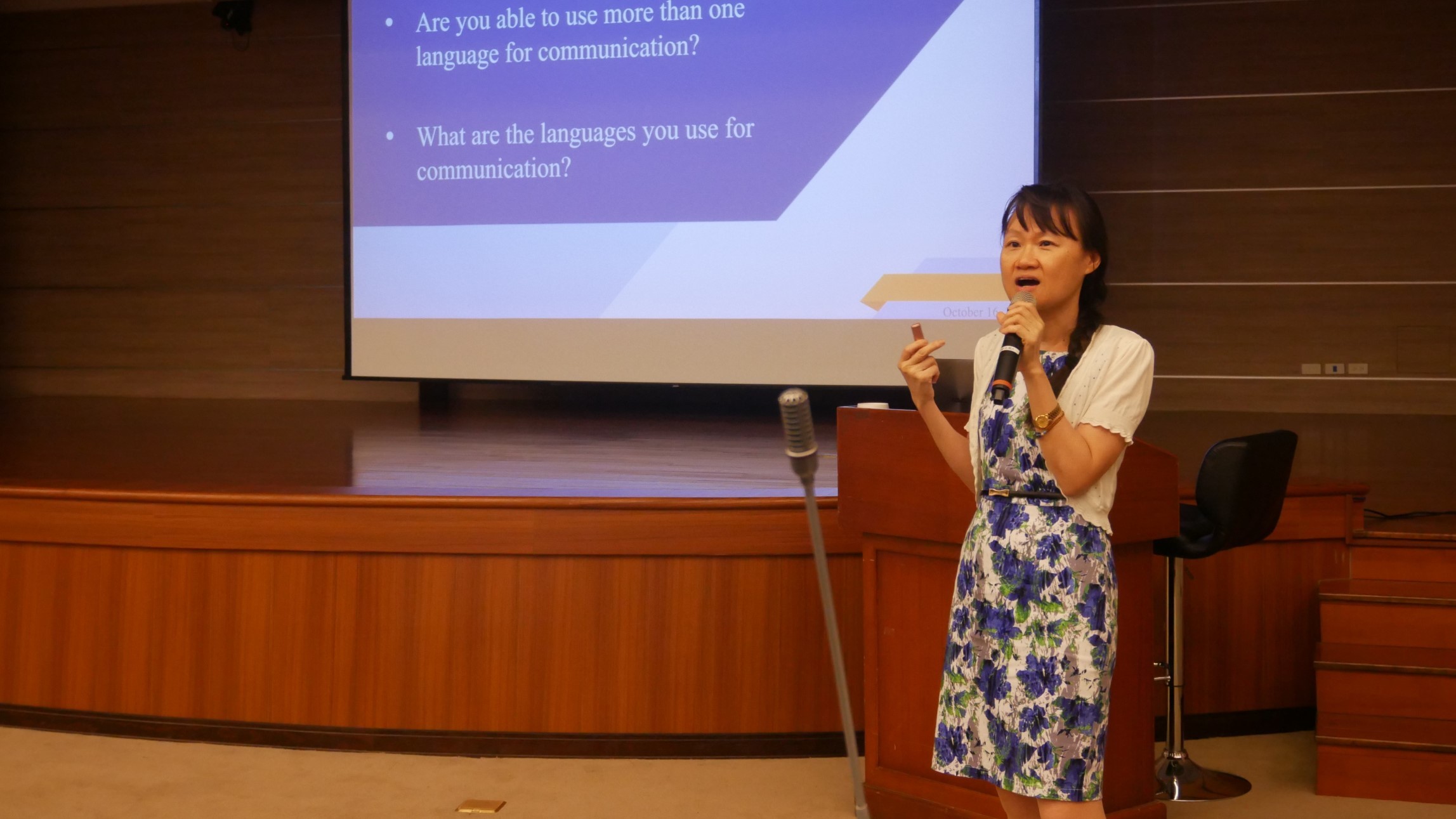
In the beginning of the speech, Professor Luo asked, ‘’ Are you able to use more than one language for communication? If the answer is yes, what are the languages you use for communication?’’ Shortly, a student replied in fluent English, ‘'I could, and it’s because I’m from Malaysia.’’ Then, Professor Luo asked, ‘’ In your imagination, what is a bilingual country?’’ The auditorium was silent for a while. Soon after, Professor Luo defined the bilingual country as a country in which its nationals use or speak two languages very well.
Not long after, Professor Luo asked, ‘’Could you give some bilingual countries as example?’’ A student who sat in the front row quickly replied, ‘’Singapore.’’ Professor Luo said, ‘’Any countries further?’’ Another student replied, ‘’India.’’ Professor Luo nodded her head and asked, ‘’ Could you provide me with a non-Asia country?’’ The audience kept silent for seconds. Shortly, the president of the College of Education replied, ‘’Canada.’’ Professor Luo said with a smile, ‘’ Excellent! And Canada is also the country where I I received my doctor’s degree.
Next, Professor Luo introduced five strategic plans launched by the MOE to achieve the goal of the bilingual-country policy, and particularly focused on two strategic plans which are ‘’Adopt a dynamic teaching approach with a focus on daily English use.’’ and ‘’Expand human resources required for English education.’’ Afterwards, Professor Luo explained the feasible tactic moves in teaching approaches, such as promoting CLIL in designated elementary and secondary schools, or promoting ESP teaching and learning for vocational schools. Additionally, when it comes to the feasible tactic movies in teacher development, Professor Luo said that the government provide in-service teachers in remote areas with a sponsored professional development program in English-speaking countries during the summer. As mentioned above, the government is making every effort to promote bilingual-country policy. Later, Professor Luo introduced the future trend in English instruction- CLIL, which an additional language is used for the learning and teaching of both content and language. The framework of CLIL are 4C, they are content, cognition, communication and culture.
In the end of the speech, Professor Luo emphasized that English will be a basic element of conversation capability in near future. If we only study English from subject, the input is not enough. Only promote Taiwan to be a Bilingual Country, Taiwanese can be competitive in the world. Eventually, Professor Luo recommended some English learning resources, such as BBC, ICRT, and TED Talk, and encouraged the audience to enhance their own English ability.
羅文杏講師在演講開始之前,先問了在場關眾「你可以用一種語言跟他人進行溝通嗎?如果可以的話,你用哪些語言進行溝通」 倏地,一個男同學便用流利的英文回答「可以,因為我來自馬來西亞。」文杏講師承先啟後的接著問道「那,你對雙語國家的想像是什麼?」全場默然思索著,「一個國家的國民能夠流利的使用兩種語言。」文杏講師為雙語國家下了一個精準的名詞釋義。
隨之,文杏講師問道「你們可以試著舉出你所知道的雙語國家嗎?」前排一個男同學迅速地回應「新加坡。」文杏講師繼續說道「那再更遠一點的國家呢?」一個女同學回應「印度。」文杏講師點頭,問道「可以給我一個非亞洲的國家嗎?」全場安靜了頃刻,坐在第一排的院長回應「加拿大。」文杏講師展顏,宛然一笑地讚揚「極優秀的答案,加拿大是我取得博士學位的國家呀。」全場聽了也不禁喜笑顏開。
接著,文杏教師便介紹教育部所提出的達成「雙語國家政策」目標的五大策略,並著重在其中的兩大策略「採用動態的教學法並聚焦英語的日常使用」以及「擴增英語教學的人力資源」。文杏講師隨後進一步闡述教學法策略的可行方法,像是在國中小推廣CLIL教學法抑或是在職業學校推廣ESP課程等等。此外,當文杏講師提及教師發展的策略之際,她介紹到有個贊助偏鄉教師至英語系國家受訓的計劃。從此可見,政府在未來將不遺餘力的推動雙語政策。文杏教師緊接介紹了未來的英語教學趨勢——「CLIL教學法」,這是一個將語言和內容相結合的教學法,而這個教學法的架構為4C,分別是內容(Content)、認知(Cognition)、溝通(Communication)、文化(Culture)。
在演講的尾聲,文杏講師再次強調未來英文將會是基本溝通能力的要素之一,若只從英文這個學科來學習英文是非常不足的,我們唯有將臺灣打造成雙語國家,才能讓臺灣學子們在國際上有競爭力。而最後,文杏講師也推薦了英語學習資源像是BBC,ICRT以及TED talk等等,鼓勵所有在場觀眾善用網路資源,以提升自身的英文水平,進而成為擁有國際視野的世界公民。
|
||
| 學生優秀心得1 | ||
|
This lecture is provided to introduce how Taiwan, a monolingual country can become a bilingual country, commence by the Ministry of Education and aim to accomplish the goal by 2030.
There are five strategic plans launched by MOE to achieve the goal of the bilingual country policy, the purpose of these strategic plans are to improve the learning motivations and potentials of the learners, prepare and enforce the human resources for local request of English teachers, to create and improve foundations and establishments for English teaching and learning facilities in Taiwan, and ultimately,bring the World closer to Taiwan so that Taiwan can be acknowledge by countries as well as global integration.
To the tactics, there are two basic and practical methods, adopting dynamic teaching approach to adjust the usage of English for daily basis, expand the numbers while maintain and improve the qualities of the teachers.
For the first tactical move, which following the “one step at a time” method.
Imagine planting a tree, the ground for the tree must be nutritious so that the tree can grow, as well as English education. The young learners, the children must grasp the basic then hone their skills when they approach audio and verbal interactions with each other and teachers. Then to the Content and Language Integrated Learning (CLIL), after the foundation of communication using English is laid, the Arts and Scientific subjects in English are suitable to introduce to the students. Not just translating the original content into English, the CLIL also use the 4C method:establish intercultural insight, the contents are new but not too abnormal, for the students to be able to express themselves and reflect thoughts on the related subjects. Nevertheless, for the first tactical move in motion, training for the teachers plays an important, if not, the most crucial role. The in-service and the pre-service teachers must be introduce and training based on the “Teaching English in English”program. The in-service teachers in rural or remote areas should be provided with profession development program in English speaking countries.
For the second move, which is to inspire and encourage students to take the mantles of their mentors.
Nonetheless there are also challenges for everyone who involve the tactics, there are the perspectives of the educators, the pupils and the curricular. For the teachers,the CLIL framework is too abnormal, even after training, incomprehension and disability to teach subject in English are expected. For the students, misunderstood of the instruction caused by the lack of vocabularies or basic knowledge is infirm for translation into another language. The curricular perspective shows that not every schools and teachers accept the CLIL program due to the fact that the textbooks are,some hard to find, preparation work can cost a fortune and time, which is really a dangerous gamble if not taken carefully.
The successfulness of a CLIL lesson is based on four criteria: the knowledge of the teacher in CLIL program, the English vocabularies are wide enough to teach the subject as well as the content of the lesson, and the most important, the ability to design a CLIL lesson. The CLIL program also need the supports from schools, staffs,parents and students, with the cooperation of these four parties, bilingual school subjects education is easily done.
To help Taiwan to become a bilingual country, education is the most basic and critical aspect. Reformation of education system is needed, monolingual school become a bilingual school, promote International exchanges in all educational levels.
Global English is set to be the standard method to educate and learn. This type of English has been used by scholars in the age globalization, since Taiwan is also consider a intercultural country, the method is suitable for both native and foreign to learn and to teach English.
Overall, I have already set my mind to be an English teacher, so this presentation is more of a presage of what I need to acknowledge of and to learn before I can really achieve my goal. To be honest, I myself have experienced a failed CLIL program, the translation of the subjects must accompanied by comparison of the original contents or miscomprehension happens, because the dual programs have two different standards of how the knowledge is delivered and used by the students, new contents must be introduce or not the students will be bored and the words of the teachers will not be heeded. This is all I have to share, so that I hope when the time comes, I can do something to improve the program so that It is accepted by everyone.
|
||
| 學生優秀心得2 | ||
|
After listening this speech, I garnered a great number of ideas, which I had never thought before. Following sentences are my points of view about this topic.
To start with, propelling Taiwan to be a bilingual country seems awesome, for it can put Taiwan into another high level in the world and make our next generation own better competitive strength to confront fierce global competition. But, under the surface of perfect imagination of becoming bilingual country, which means that we should learn well both language instead of forsaking our mother tongue to pursue a powerful language-English, we still have a big paceneed to across, like fostering our advanced teachers and create more suitable resources for students. Due to the fact that students who major in education-related subjects, just like me, are more likely be an instructor in the future, so we should take the responsibility to polish up ourselves to the target being an good bilingual teacher.
Once we can conquer those challenges, such as how to directly use plain English words to describe a new proper noun even a technical term to little kids, our education will reach a brand-new milestone.
In this speech, professor Luo said accent is not really a problem for a teacher teaching English in Taiwan; I do agree with this point, since there are so many different accent in the world, and how can we choose one from them and set it as a standard! However, when we talk about more literally problem: "why some parents would believe a native English speaker to teach English to their child would be better?" To some extent, accent plays a vital role in this answer. Because we are Taiwanese, distinguishing what a Taiwanese English teacher saying would not be too hard, as his/her accent is somehow familiar with. But if the speaker is a person with heavy British or American southern accent, we may fail to figure out what does he/she mean or misunderstand he/she. I can boldly to make a conclusion that, although we should not mind showing our Taiwanese accent when having conversation with foreigners, but we had better training our listening to accustom ourselves to different accents.
|
||
| 學生優秀心得3 | ||
|
In this lecture, our English professor told us how to turn Taiwan into a bilingual country based on our government policy. From this lecture, I saw that how challenging is it to build up a new educational system. Nevertheless, via this policy, I seek a chance for my future career, for that I’m the student of the department of English Instruction. In the CLIL program, I perceive it an advanced improvement for our education and it can further bridge the gap of our textbook content between high school and university. On the contrary side, adopting this kind of education means would probably cause the difficulty of receiving high education because it may raise the level of understanding the textbook and even cause students to abandon learning, since that even the content is in Chinese many of Taiwan students give up learning.
By setting up the CLIL program, it will be necessary to train well-prepared teachers, and this will also encounter a dilemma. On one hand, new teaching strategy is believed to create more thoughts and energy in our educations. Students can have the chance to escape the old style of learning and going to cram school, and new teachers may come up with more creative activities to evoke the student’s passion for learning. However, on the other hand, the new system will be very complicated compare to the one we are using. The first thing we need to deal with is that the distribution of the duty among teachers who expert in different subject and realm. Moreover, how does the newly trained teachers cooperate with the origin teachers is a big issue to tackle.
In my own perspective, I consider to have CLIL and our origin way of learning combine together. We can learn a subject in English, but also learning it in Chinese. I think by doing this, students can receive knowledge in different aspect, which is in the view of English-written text book and Chinese-written textbook. Furthermore, student can compare those to aspects and discover their own unique knowledge. And also, I think that if we have textbook and courses in both languages, it can lower the anxiety and opposition of students. After having this class, I truly agree the importance of acquire multiple languages, but if it is necessary for Taiwan to turn into a bilingual country and implement a language that seldom matches our local culture is a doubt I have. After all, we can still have fluent English if we do hardworking, pace we can still speak poor English even we turn into a bilingual country.
|
||
| 學生優秀心得4 | ||
|
First of all, I would like to thank the speaker gave us so many information and experiences by asking us to share our thoughts and interacting with us. But I don’t think it’ll be that easy to make Taiwan become a bilingual country. Just talk about the basic side, we have to translate the laws into an English version, all the papers from or for the government will need an English copy, and the most important one, which the speaker introduced, the education has to be done by using English. For the teachers who are already teaching in schools, most of them don’t have the ability of using English to explain their field completely as using Chinese. Therefore, the students won’t be able to learn as much as and as detailed as the students like us. During the speech, someone asked a question about the importance of the teacher’s accent when the project is going on, I don’t really agree with the speaker’s opinion, I think we should care more about the accent, further more, the pronunciation. Because as soon as we wanted to transform, it’s better that we try our best, we do have the possibility to pronounce like native speakers, it’s just depends on the concept and the motive. Other countries can be a bilingual country is often because that they have part of the citizens that speak another language, such as Singapore, their families and social environment make the people bilingual easily and naturally. If we really wanted to turn Taiwan into a bilingual country, first we’ll probably face the strikes for different careers, like teachers, civil servants, nurses, and so on. So are we really ready for this change? I think we can start from educating teachers to speak English and try to teach in English, not replace them by training bunch of freshmen and giving them pressure. Just like the bus drivers, they are a successful example. And we can have more TV programs speaking English, let this language come in our life. I would love to see Taiwan become a more competitive country, it’ll affect our position on the world, but we might not success by 2030, and there are still lots of strategy that we could make it better. |
||
| 活動照片 |
 |
 |
 |
|---|