
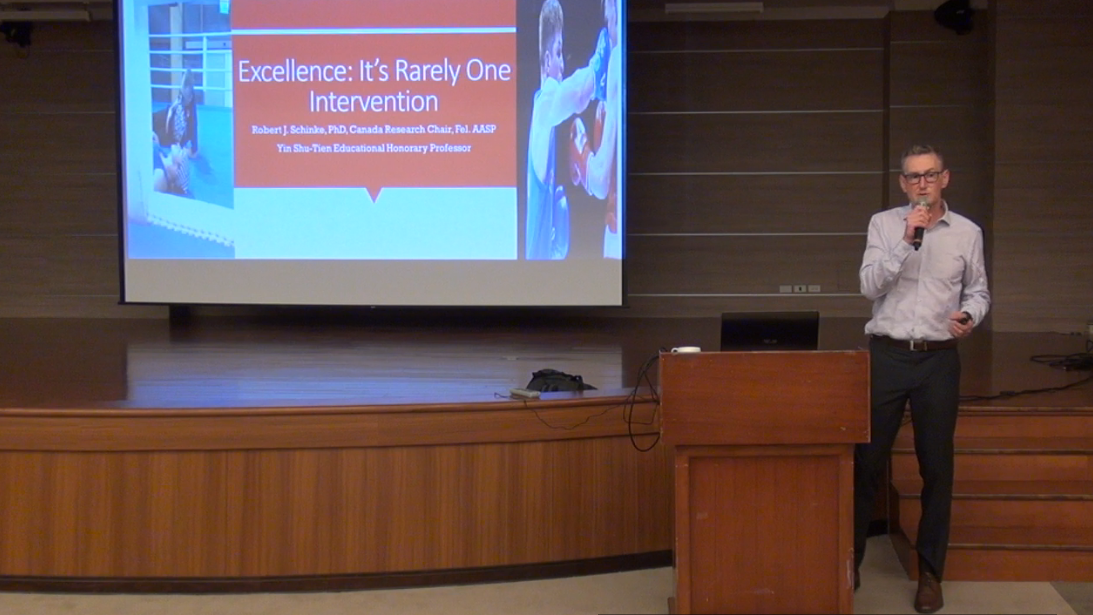
《Excellence: It's Rarely One Intervention》加拿大Laurentian大學Robert Schinke教授
| 講者介紹 | 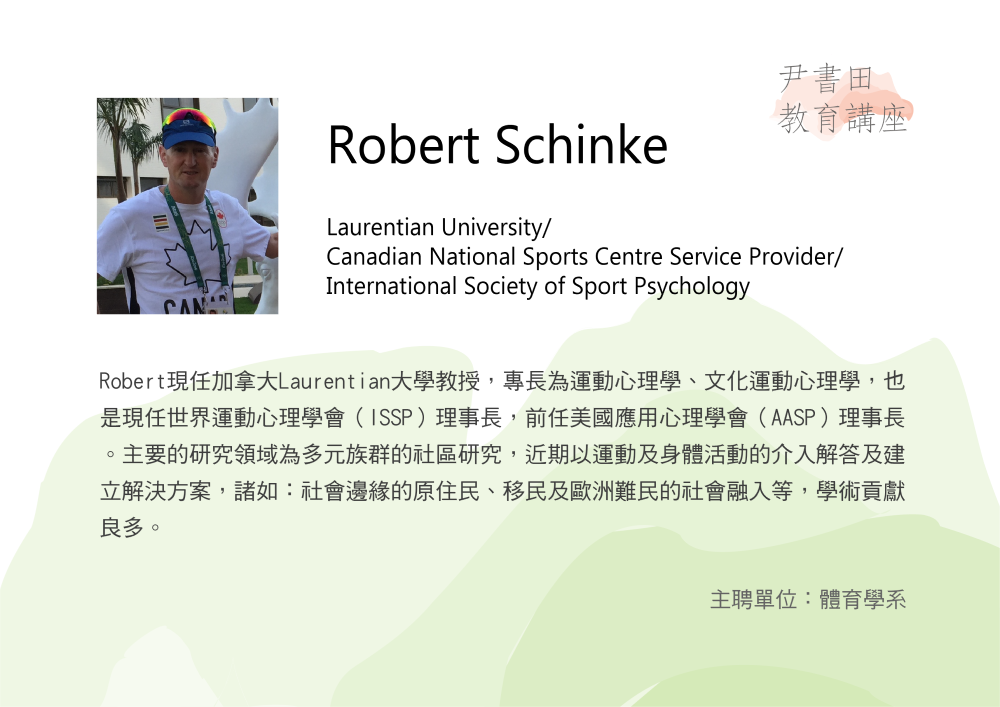 |
|---|---|
| 活動紀錄 | ||
|---|---|---|
|
演講剛開始,講者強調了心理健康的重要性「每天花60-90分鐘進行跑步,瑜伽,散步或任何形式的體育鍛煉。當我們開始鍛鍊自己時,我們會變得更有效率、更有產能,並且能夠為工作和同事付出更多。」此外,演講者提醒聽眾們盡可能地多與積極,支持性高的人打交道、做朋友。演講者也甚至開玩笑地說道:「我是無法容忍跟消極的人們處在一起的。」
後來,演講者談及睡眠的重要性。演講者鼓勵聽眾了解他們自己的睡眠週期,例如:「什麼時候結束工作?」,「什麼時候開始放鬆?」,「什麼樣子的活動可以幫助您入睡?」 這些問句看起來十分簡單,但是它們確實幫助我們更好地了解了我們的睡眠週期或習慣。」
接下來,演講者介紹如何與挫折相處,「首先,在經歷挫折之後進行自我評估。其次,聽取好的心靈導師的回饋並接受。我們樂見於錯誤發生,它是讓我們得以成長的機會,我們應抓住學習的機會並向前邁進才是。」講者對於錯誤的見解確實改變了大多數聽眾原先對挫折的看法。
講者在最後強調「沒有時間比得上現在。」他鼓勵所有學生珍惜每一刻,抓住每一天。 「別忘了,及時行樂!與周圍的朋友們保持康、樂觀的心態,這些都會彼此感染的。」此外,講者還提醒道「練習自我覺察!一切的改變從自我覺察開始。」顯然地,自我覺察是保持心理健康的首要關鍵。
Not long after, speaker emphasized the importance of the mental health, ‘’Take 60-90 minutes every day for running, yoga, walking, or some form of physical activity. When you give to yourself, you are more productive and able to give to work and colleagues.’’ Additionally, the speaker reminded the audience to hang around positive, supportive people, as much as possible. The speaker even jokingly said, ‘’I have no tolerance with wrong people.’’
Later, the speaker talked about the importance of the sleep. The speaker encouraged the audience to understand their own sleep cycle, for instance, ‘’When do you finish work?’’ , ‘’when do you begin winding down?’’ , ‘’what kind of activities can lead you into sleep?’’ These questions looked simple, but they really helped us to have a better understanding of our sleep cycle or habit.
Next, speaker introduced how to get along with the setbacks, ‘’ First, engage in self-evaluation after setbacks. Second, listen to feedback from a good mentor and take it in. Mistakes are ok, they are opportunities for you to improve, just seize your learning opportunities and move forward.’’ What the speaker said really change most audience’s perspective of the setbacks.
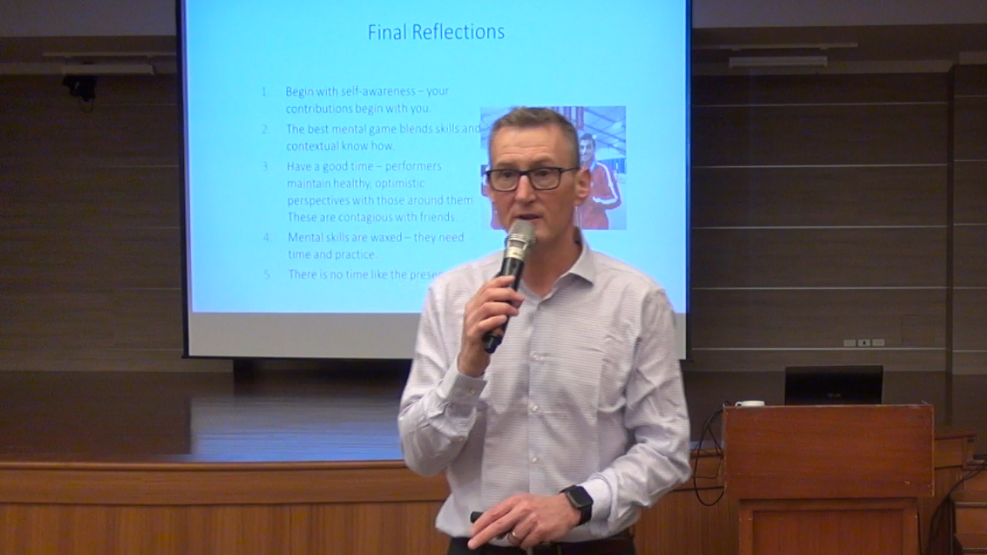
In the final part, speaker emphasized, ‘’ There is no time like the present.’’ He encouraged all the students to cherish the moment, and seize the day. ‘’Have a good time – performers maintain healthy, optimistic perspectives with those around them. These are contagious with friends.’’ Moreover, speaker also reminded that, ‘’
Begin with self-awareness – your contributions begin with you.’’ Apparently, self-awareness is a key to be mentally healthy.
|
||
| 學生優秀心得1 | ||
|
1. Lecture Summary
In the lecture, the speaker talked about how to become a better version of ourselves by the same ways that he uses to help Olympic athletes. The first thing to note is that we have to pay attention to our health. Getting quality sleep, eating nutritious food and exercising are all very important.
There’re also some tips to help us achieve our goals. First, we set our goals. The speaker suggested that we write down our goals on pieces of paper and stick them everywhere, so that we can see them many times and be constantly reminded. Second, we can keep a “checklist” in our mind and make one right decision at a time. Moreover, we should try to be prepared on a daily basis, asking ourselves “what do I want to achieve” before doing things. Last but not least, we should be self-aware. Try to evaluate our good days and challenging days, so that we’ll know what to do when we need a good day.
2. Reflection
The lecture is inspiring for me, and the speaker is very convincing. I really appreciate that he provides some steps to help us put those concepts into practice. It’s also quite surprising that a little bit of change can make a lot of difference. For example, he suggests that we try to make one decision at a time, and we can have a checklist in our mind to check out everything we’ve done right. I find that really useful because even though is a fairly simple thing to do, it does help a lot with the anxiety before important events. When I do things like that, I find myself being more relaxed and confident, and the events don’t seem so terrifying anymore. Evaluating good days and bad days is also an interesting idea. It would definitely be good to know the factors behind them, instead of simply blaming them on fate.
After the lecture, I think that I probably should try something out, so I decided to list my goals. To me, I think my biggest problem is the tendency to procrastinate. Procrastination can cause me a lot: sleeping time, time to try new things and also time to exercise. Therefore, if I want to become a better version of myself, I think this will be my first goal: start to do important things immediately without procrastinating. Next, I usually don’t get enough sleep, which causes me to sometimes doze off in class. As a result, my second goal is to get enough sleep. Lastly, I think I also have to start having breakfast every day. Hope that I could achieve these goals soon.
|
||
| 學生優秀心得2 | ||
|
The speech this week Global Perspectives on Education class was about self-awareness, goals, mental health and so on. The speaker delivered us these notions by taking athletes as an example. For instance, the speaker talked about health in the beginning. How can we become mentally healthy? First, not to put too much effort focusing on your work, instead, take 60 to 90 minutes doing some physical activities like running, yoga, walking can help you become more productive and concentrative. Also, sleep enough is important, too. Take me myself as an example, every time I stay up late to rush my homework or reports, the results don’t often turn out well, most of the time, there are spelling mistakes, wrong grammars, sometimes, I can’t even explain what I was trying to express through the sentences at my time rushing. I think, for me, get more sleep and do the work more energetic will be more efficient. Then, the speaker also mentioned being self-aware. The athletes should be self-aware or else they will definitely fail. They should learn to engage in self-evaluation, and also listen to feedback from others and take it in to seize their opportunity of learning. Making mistakes isn’t a big deal, what matters is whether you learn from that mistake and move forward. I was in table tennis team when I was still an elementary school student. Comparing to the same age, my height is one of my strengths as a table tennis player. I can easily hit the ball since I have longer arms. This of course made me the first team player and earned me lots of awards. However, I didn’t listen to my coach’s instructions which told me to move my whole body instead of just moving my arms. As time passed by, I became clumsy and not flexible anymore. So I quit my career as being a player.
|
||
| 學生優秀心得3 | ||
|
The talk for me was very interesting, for me is it told us how to properly take care of ourselves, the most basic thing we need is 8 hours of sleep and stay hydrated but that’s the things we forget the most. Especially for us students who sacrifices sleep for unnecessary things at the end we tend to procrastinate. Dr. Robert also told us to in order to success you need to manage your time wisely, thinking of it why do I always say “I’m so tired” and “I’m so sleepy”? It’s probably because I didn’t manage my time wisely, it also because I don’t eat my meal on time so when I go to class my blood sugar will go down and I’ll feel exhausted.
Every time there’s an exam coming students tend to procrastinate and study last minute the night before the exam in this case our mood and mindset gets ruined because of procrastinating, we’re panicking because there’s a little time left before the exam and you’re packing again because you’re panicking. Your mindset will say that you will not pass the test anyway and you end up giving up which is not good. But honestly in my opinion I think it’s better to go in an exam to know you’re going to fail than to be full of confidence that you will pass, it is because if you’re too full of yourself you might get depress when you didn’t pass the exam. In every decision you make there will be consequences just for example if you chose to go out instead of studying you’ll end up failing the exam, that’s why Dr. Robert said that in every decision you make you need to think about it a hundred times another example is when you said a bad word to someone out of angry, once you said it you can not take it back anymore
Dr. Robert totally change the meaning of “productive” for me, because before the talk to word “productive” for me is that you have done many task, paper task, but then Dr. Robert made me realize being productive is not just about sitting in the office and finishing paper works it should be also about considering one’s health. You could be productive in the office for finishing paper works but you are forgetting to take care of yourself. You may have done a lot of work but it may make your life short.
|
||
| 學生優秀心得4 | ||
|
“Excellence, it’s rarely one intervention”, the topic alone was outstanding, because I could hardly guess what the speaker was intending to share with us, and it was indeed a powerful speech.
To me, or at least what I’ve learned and observed from my parents and especially grandparents, selfcare was a…guilty action. Well, technically, according to the Bible, men were supposed to work hard, and women had to bear the pain of delivery, but God never said not to care for ourselves, right? Seems that the elder generation neglected the fact that they should rest enough, but chose to work and get nearly burn out, or rather they were forced to due to the economic states and historic background. Hence, as selfcare be introduced to our lives now, it’s hard to accept that we deserve to rest, to adjust, to nourish our body in order to perform better. I, too fell victim when I was in high school, I felt that I didn’t deserve the good deeds and all I would do was often starve myself, stay up late to study and wake up early to train running, hate myself when standing in front of the mirror.
Things changed when I was introduced to the fitness world, where these words “selfcare”, “goal setting” and “nourish the body” appeared in my life (my phone actually) for the first time. I have super high expectations for myself, and whenever I set a goal, it drives me crazy and often have emotional breakdowns to reach it. It was until then did I realize that my goals weren’t realistic, and I’ve been too harsh on myself.
However, as I started to get in the flow of selfcare, it did backfire, I backfired myself, probably because I was no longer exercising self evaluation and doing the caring part wrong: I was giving permission to myself to “goof around” and gave myself all the perfect excuses not to train as hard (aka lazy) and eat a tremendous amount of food gradually leading to bulimia, which I am still suffering time to time now.
Excellence, is also done in moderation.
It took quite some time dealing with myself, my family, in church, to realize and determine my own lifepath, to be enlighten to become the best version of who I am, not compared with others. Whether it is my personality, determination, organization or other factors that build the girl in me. To me, efficiency was almost everything I chased for during the past 6 years, but I learned now that not all things can be done in speed. Through the professor’s speech, he helped me understand how to set my goals and maximize them. “Never more than three goals, one is long term, and the other two are strategies. Write them down and stop to read them when you go over the notes”, he said, and I did the exact same thing. It’s not easy to keep this in mind unless you have enough willpower. I have to know how to turn on my body, like a switch, and being self aware of all the things passing through my mind. He also talked about “Day planning and arousal, enter the readiness.” These are overall small but useful tips to improve myself every single day of my life.
Lastly, professor mentioned that “Mental skills are waxed, they need time and practice.” I’m trying to, and I’m confident to say that I will succeed and make this a lifestyle, no matter how many times I’ve failed already, I will hold on.
|
||
| 活動照片 |
 |
 |
 |
|---|
瀏覽數: